Saturday, March 17, 2012

Experiment To Water Plants, Based on Dr. Masaru Emoto's "Hidden Messages In Water"

New Experiment

I'm conducting a new experiment, based on Dr. Masaru Emoto's findings in his book "Hidden Messages In Water" (as seen in the movie "What The Bleep Do We Know").  Dr. Emoto states that the structure of water molecules changes in response to the messages received via word, music and thought messages,

I'll water three sage plants of similar height and fullness (shown in the photo below) with three different jars of water.  I bought all three plants at the same local plant nursery on March 15, with the assumption that all three have received the same care. 


One plant, as a control, will receive regular City of San Diego tap water.  The second plant will receive tap water which will be given positive messages.   The third plant will receive tap water which will be given negative messages. I filled three glass canning jars at the same time, and all three  have been handled the same way other than the two receiving the positive and negative messages.

The second jar of water has been covered with sticky notes on which I have written positive messages:  Love, Peace, Joy, Truth, a drawing of a flower, and a drawing of a heart.  It has been placed in my bedroom where I play soothing meditation music.

Image of Dr. Emoto's frozen water crystal after receiving the words "Love and Gratitude"


The third jar of water has been covered with sticky notes on which I have written negative messages:  Hatred, Demon, Lies, Poverty, Anger. Hunger, Disease.  It is in the living area near the TV (which produces a lot of negative messages and where my son plays video games of war and death and destruction). I will also be playing heavy metal music in this area occasionally for the purpose of this experiment.

Image of Dr. Emoto's frozen water crystal after heavy metal music is played


Each of the sage plants will be labeled, and each will receive water from its designated jar throughout the experiment.  It will be interesting to see the effect on the plants in the next 2-3 weeks.  I'll post photos of the plants every 2-3 days to show how they look.

Do you think they will all grow the same?  Or do you think the water they are given will have an effect on them?

Sunday, March 11, 2012

Effect of Microwaved Water on Basil Plants: The 20 Day Test

Ok, so I got an email from my cousin - you know, one of those viral emails that everyone forwards?

This email claimed that an elementary school student's science project tested the effect of microwaved water on a plant, with a second plant acting as control and given tap water.  The photos in the email were pretty dramatic, showing the plant receiving the microwaved water as shriveled and dying.  I checked Snopes.com (also known as Urban Legends) and they reported that it was False.  Here's the link to the report on their website:
http://www.snopes.com/science/microwave/plants.asp


Well, emails went back and forth between me, my cousin, and several other recipients on the email list, debating if it were true.  As a result of this flurry of emails, I took up the challenge to perform my own experiment.

I went to my favorite local plant nursery, well-known for the quality of its plants, and chose two basil plants that were as similar as possible (Why basil? Cause if they survive, I can always harvest them and add them to my spaghetti sauce, right?)

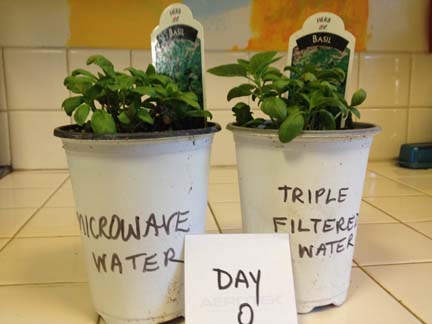
I brought them home and placed them both on my kitchen windowsill, side by side. They were in the same environment and received the same amount of sunshine.  Here's the two plants the day I bought them - Day 0.  Same height, same fullness, same healthy green color.


Day 0
 That first day, I filled a glass bowl with tap water and microwaved it for two minutes, until it was boiling, and let it cool to room temperature, then poured it into a pint-size canning jar and put a lid on it.

I filled the teakettle with tap water and heated it on the stove until it boiled, then also let it cool to room temperature, and poured it into a quart-size canning jar.  I used different sized jars so I could easily tell them apart and ensure they wouldn't get mixed up.

Since the plants had been watered at the nursery the day I bought them, I waited until Day 2 to water them at home.  Here's a photo of the plants on Day 2.  They both still look the same.

Day 2

I watered the plants every other day, and they continued to sit side by side on my kitchen windowsill.  There wasn't any noticeable difference for several days, but then by Day 10, I could tell the plant getting the microwaved water was looking puny, while the plant getting the boiled tap water was thriving:

Day 10

I felt so sorry for the poor thing, I decided to try to resuscitate it by giving it and the other plant both some rain water and a little direct sunshine out on the patio, since it was a nice warm day.

But when I emailed my cousin and told him I planned to rescue the plant, he encouraged me to continue the experiment and do a taste test after the plants grew bigger.  So I continued to give the one plant the microwaved water, and the other plant the tap water boiled on the stove.

At Day 20, here is what they look like:

Day 20

 The poor little basil plant getting the microwaved water is nearly dead. 

I don't know about you..... but I'm avoiding using the microwave from now on!

Do you think I should send this to Snopes and let them know that in this case, it's True that microwaved water will kill plants?

Wednesday, March 7, 2012

Coriander Oil Treats Food Poisoning, and Drug-Resistant Infections (MRSA)


Coriander Oil (cilantro) Can Be Used to Treat Food Poisoning and Drug-Resistant Infections (MRSA)     
by Jonathan Benson, staff writer, Natural News

(NaturalNews) Food-borne illness outbreaks and the growing prevalence of antibiotic-resistant "superbugs" are two very serious societal problems for which researchers say they are actively looking for viable solutions. But one such solution found right in nature is coriander oil, which has been found to kill a number of different bacterial strains, as well as aid in digestion and treat the symptoms of food poisoning.

Dr. Fernanda Domingues and her colleagues from the University of Beira Interior in
Portugal tested the effects of coriander oil, an essential oil extracted from the seeds of the coriander plant, also known as cilantro, on twelve different bacterial strains, including Escherichia coli (E. coli), Salmonella enterica, and methicillin-resistant Staphylococcus aureus (MRSA), the infamous hospital superbug.

Published in the Journal of Medical Microbiology, their findings revealed that solutions containing just a 1.6 percent concentration of coriander oil or less were all effective at killing all twelve bacterial strains, to some degree or another. A powerful, natural antibiotic, coriander oil appears to be a promising candidate for new uses not only in food preservation, but also in medicine as a type of natural antibiotic.

"The results indicate that coriander oil damages the membrane surrounding the bacterial cell," said Dr. Domingues about how the essential oil works. "This disrupts the barrier between the cell and its environment and inhibits essential processes including respiration, which ultimately leads to death of the bacterial cell."

Besides its antibacterial effects, coriander oil has a wide range of other therapeutic uses as well, including as an analgesic (pain reliever), anti-rheumatic, antispasmodic, and anti-fungal medicine. Used in many Indian dishes, coriander seeds and oil are also recognized as powerful digestive aids that can mitigate the damage caused by food poisoning, as well as stimulate and revitalize the body (http://www.mountainroseherbs.com/learn/eo/corianderseed.html).

"This research encourages the design of new food additives containing coriander oil that would combat food-borne pathogens and prevent bacterial spoilage," added Domingues. "Coriander oil could also become a natural alternative to common antibiotics. We envisage the use of coriander in clinical drugs in the form of lotions, mouth rinses and even pills; to fight multidrug-resistant bacterial infections that otherwise could not be treated."

To learn more about the amazing health benefits of coriander oil, visit:
http://www.globalhealingcenter.com/benefits-of/cilantro

Sources for this article include:

http://www.sgm.ac.uk/news/releases/JMM.2408.FD.cfm
All content in this article is commentary or opinion and is protected under Free Speech. Truth Publishing LLC takes sole responsibility for all content. Truth Publishing sells no hard products and earns no money from the recommendation of products. NaturalNews.com is presented for educational and commentary purposes only and should not be construed as professional advice from any licensed practitioner. Truth Publishing assumes no responsibility for the use or misuse of this material. For the full terms of usage of this material, visit www.NaturalNews.com/terms.shtml

Friday, March 2, 2012

Drink More Water

Functions of water in the body: Within the body, water is an essential component of tissue cells and all body fluids. It also acts as a universal medium in which many chemical reactions take place. It acts as a carrier aiding digestion, absorption, circulation and excretion.

It is essential in the regulation of body temperature, acts as a lubricant for joints and visceral movements within the abdomen, and is the medium in which virtually all your water products are eliminated.

Daily Water Losses and Gains:  Normally the body will eliminate about 72 ounces of water a day via the lungs as water vapor, the skin as sweat, in our stools, and by the kidneys as urine. About 12 ounces is formed in the cells as an end-product of food metabolism. If the net loss is not taken in, we become dehydrated. Most folks are.

Dehydration: Water is more essential to life than food. We may go for weeks without food, but only days without water. We may lose all of our reserve glycogen and fat and about half of the body protein without great danger, but a loss of 10% of body water is serious and 20-22% is fatal.


The average person does not drink enough water:  One guide to use is half your body weight in fluid ounces. So, a person weighing 150 pounds would need to drink 75 ounces daily to stay well hydrated. At first a lot of water may be required to flush the waste products and toxins from the blood and tissues. As this normalizes, less will be required. A minimum of eight 8-oz. glasses/day is necessary at all times. 

Cool water is ok, but ice water should not be taken. Room temperature or slightly warm is best.

Do you think that you are drinking enough water every day?  What would help you drink more water than you are now?

Friday, February 24, 2012

Sage Improves Memory, Study Shows

Web address:
     http://www.sciencedaily.com/releases/2003/09/
     030901091846.htm

Sage Improves Memory, Study Shows

ScienceDaily (Sep. 1, 2003) — New research has proved that sage can improve memory, confirming centuries-old theories. British scientists have carried out the first clinical trials with healthy, young adults and found that those who had taken sage oil capsules performed significantly better in a word recall test.

The team, from the Medicinal Plant Research Centre (MPRC) at the Universities of Newcastle and Northumbria, have provided scientific evidence for claims dating back centuries.

They studied texts by well-known herbalists such as John Gerard, who wrote about sage in 1597, saying that 'It is singularly good for the head and brain and quickeneth the nerves and memory", and Nicholas Culpeper, whose 1652 text says "It also heals the memory, warming and quickening the senses".

People were known to take sage for memory loss centuries ago and drank teas and tinctures containing extracts of the herb.

The results of the study are published in the current edition of the academic journal Pharmacology, Biochemistry and Behaviour *.

The Newcastle team tested 44 healthy young adults aged between 18 and 37. Some were given capsules containing sage oil and others were given placebos.

The volunteers then took part in a word recall test and tested at intervals to see how many words they could remember. Results showed that those who had taken the sage oil consistently performed better than those who had taken placebos.

Sage is being investigated as a potential treatment for Alzheimer's Disease after earlier research by the MPRC found that it inhibits an enzyme called acetylcholinesterase (AChE) which breaks down the chemical messenger acetylcholine. Alzheimers', the most common form of dementia which affects an estimated 10 million people worldwide, is accompanied by a drop in acetylcholine.

Many of the current drugs, such as donepezil, have unpleasant side effects and doctors are keen to find alternatives. No side-effects were noted in the sage trial.

Further investigation is needed to find out why sage is so effective but researchers think it could be a combination of chemicals in the oil which have an effect on AChE and which give it antioxidant, oestrogenic and anti-inflammatory properties, also considered to be of value in Alzheimer's therapy.

Lead researcher Nicola Tildesley said: "This proves how valuable the work by the old herbalists is, and that they shouldn't just be ignored because they were writing centuries ago.

She added that people who were taking exams should not get too excited by the findings: "Test would need to be carried on people over a longer period of time to prove that sage improves exam performance but we don't have any plans to do this at present.
"However, this research does have serious implications for people suffering from Alzheimer's Disease, as it will inform drug research and development."

The research was funded by Oxford Natural Products. The MPRC is carrying out another clinical trial where sage is being tested on people with Alzheimer's, and results from this are expected shortly.

* Journal ref. Salvia lavandulaefolia (Spanish Sage) enhances memory in healthy, young volunteers, NTJ Tildesley et al, Pharmacology, Biochemistry and Behaviour 75 (2003) 669-674.
Recommend this story on Facebook, Twitter,
and Google +1:

Other bookmarking and sharing tools:
| More

Story Source:
The above story is reprinted from materials provided by University Of Newcastle Upon Tyne.
Note: Materials may be edited for content and length. For further information, please contact the source cited above.


APA

MLA
University Of Newcastle Upon Tyne (2003, September 1). Sage Improves Memory, Study Shows. ScienceDaily. Retrieved February 24, 2012, from http://www.sciencedaily.com­ /releases/2003/09/030901091846.htm
Note: If no author is given, the source is cited instead.
Disclaimer: This article is not intended to provide medical advice, diagnosis or treatment. Views expressed here do not necessarily reflect those of ScienceDaily or its staff.


For more information about essential oils, please go to my website:
www.youngliving.com/laurasoils
 

Sunday, February 19, 2012

Gary Young's Story, Founder of Young Living Essential Oils

I had the opportunity Tuesday night to attend a talk given by the founder of Young Living Essential Oils, Gary Young and his wife Mary.

Gary Young

He told us his incredible story of suffering a near-fatal logging accident in 1973, which resulted in him being in a coma and ending up paralyzed and in a wheelchair – for life, according to his doctors.  This accident — which nearly cost him his life — transformed him both physically and emotionally and would eventually impact the lives of countless people in ways he could have never imagined.

His quest to regain his life eventually led him to discover the potential of a powerful but little-known form of natural medicine — essential oils. Within a very short time, Gary cast off the persistent pain that he had borne for almost 13 years as he began tapping the power of essential oils. By 1986 he was able to run a half-marathon, finishing 60th out of 970 participants.

Today he has amazing strength and stamina, working on his many farms where he grows and harvests the plants that are distilled on site into these pure, pharmaceutical-grade essential oils.  His story and experiences are truly an inspiration to explore these essential oils.  I'm eager to learn as much as I can about them!

If you're interested in them, too, you can find out more at my website:
www.youngliving.com/laurasoils

To Your Health!